Warning: Parts of this blog are going to feel like an advertisement for my consultancy work and books. This is unavoidable as I have written this for those who ask me about the issues relating to reading instruction that I see across primary schools and how I seek to address them.
In this blog, I’d like to explain how I try to support schools and, in the process, offer some thoughts about patterns that I see that might be of use to classroom teachers and school leaders.
I spend a few hours most weeks in conversations with school leaders talking about their current reading provision. In some cases, these online chats are the pre-cursor to my working with their school. In other cases, schools simply want constructive feedback on their current approach to reading. As a result of these conversations, I have identified a number of recurring issues with schools’ approaches to reading lessons, of which these are by far the most common and important:
- Fluency development is not explicitly targeted through scaffolded reading practice.
- Reading lessons involve precious little actual reading, especially of whole texts.
- There is a lack of text discussions aimed at developing pupils’ appreciation of written language and their active, personal role in reading.
As a result of these conversations, I have become increasingly convinced of the importance of teachers and school leaders knowing the fundamentals about reading development, something I generally refer to as the theory behind reading: the connections between word recognition & the structure of the English writing system; the connections between decoding, fluency & comprehension; the integrated bodies of knowledge required to make sense of a text; etc.
I have consistently found that schools that understand this domain make better decisions in how they approach the teaching of reading. Often I work with schools that are less confident with this domain, helping them to better understand reading so that they can develop their approach to reading with greater confidence. This work ranges from hour-long keynote presentations to professional development days. Central to this work is my reading map, an aide memoire for the key things I believe every teacher and school leader needs to understand about reading:

(A 9-minute introduction to this reading map can be found here: link to YouTube video)
For some purposes, I am wary of one-off professional development sessions. If you want to support teachers to make practical changes in the classroom, sustained support is required. But when it comes to helping schools to strengthen their grasp of reading development and identify potential areas for future improvement, I’m confident that this sort of work can be useful.
However, some schools and MATs want considerably more than this. Specifically, they want to be shown a particular approach to reading lessons beyond phonics that they can adopt, adapt or merely use as a jumping-off point for change. In these cases, initial support on the theory behind reading is usually followed by three sessions that help schools to balance the three priorities addressed by every effective approach to teaching reading lessons:
- Build reading fluency through practice.
- Read plenty of thoughtfully chosen texts.
- Discuss texts in depth.
Specifically, I discuss in detail how to teach using three reading lesson structures, each of which matches one of the above priorities:
- Fluency reading
- Extended reading
- Close reading
These reading lesson structures are not stunningly innovative or hugely difficult to pull off. They are also certainly not the only way to meet the three priorities of reading lessons. They are simply ways of organising reading lessons that aim to meet the needs of developing readers while providing teachers with the mixture of support and agency required for high-quality teaching and ongoing improvement. Usually, I introduce teachers to these lesson structures one at a time with a gap of at least a couple of weeks between them so that teachers have the chance to experiment in the classroom and get support with any initial challenges to implementation. (For schools who want more flexibility or those in parts of the world that make live professional development difficult, I also have a sequence of videos that can be used for this professional development.)
That’s basically it. Of course, there are other issues that I help schools with (how to systematically assess & address reading difficulties; how to build a reading curriculum; how to nurture a reading culture; etc), and the work that I do is moulded to meet the requirements of each individual school or multi-academy trust. But I can sum up the vast majority of the consultancy work that I do thus:
(1) I provide constructive feedback on schools’ current approach to teaching reading and their reading curriculum either as part of informal online conversations or formal in-person consultancy.
(2) I help classroom teachers and school leaders to better understand reading development so that they can make better-informed decisions about their approach to teaching reading.
(3) I explain in detail one specific evidence-informed approach to reading lessons that schools can then adopt, adapt or use merely as a jumping-off point.
The last thing to say is that I always try to provide a free or cheap alternative to any consultancy work that I do. I do not want schools to spend money they don’t have, and I don’t think I could ever justify earning more than I did as a school leader.
The free version of (1) is available to anyone who works in a state school; just drop me a message via email, Twitter or Blue Sky with any questions, and I’ll do my best to answer them. If things are more complicated (and I’m not too busy), I might offer to follow up with a brief online chat via Zoom.
The cheap version of (2) involves buying my first book, The Art and Science of Teaching Primary Reading, which is designed to help schools understand the key theory behind reading and how it relates to practice: https://www.amazon.co.uk/Science-Teaching-Primary-Reading-Corwin/dp/1529764165

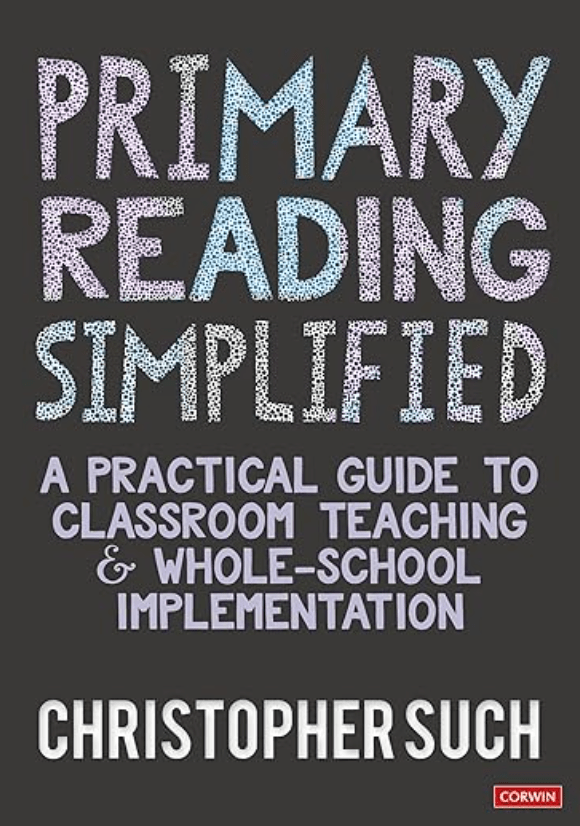
The cheap version of (3) involves buying my second book, Primary Reading Simplified, which is designed to provide practical guidance for every aspect of classroom teaching and whole-school leadership relating to reading. This book goes far beyond just addressing (3), but the core of the book does this: https://www.amazon.co.uk/Primary-Reading-Simplified-Whole-School-Implementation/dp/1036201414

Below are testimonials from schools and multi-academy trusts that I have worked with:
“We’ve absolutely loved working with Chris across our trust. His reading CPD has been a real game-changer, not just for how we teach reading, but for how we think about teaching in general. His sessions are full of practical ideas, grounded in research, and delivered in a way that’s clear, engaging, and genuinely useful.
One of the things we’ve really appreciated is how approachable Chris is. He doesn’t just deliver the training and disappear—he’s been brilliant at answering follow-up questions and offering support whenever we’ve needed it. That kind of ongoing help has made a big difference in helping staff feel confident and supported.
The impact has been clear across our schools. Teachers are feeling more empowered, pupils are more engaged, and the quality of teaching has stepped up a notch.”
– Aimee Tinkler, Head of Education at Diocese of Coventry MAT
“The impact from Chris’s reading CPD has been superb, really helping to bring to life the EEF recommendations. Our teachers now have a much clearer understanding of how to develop vocabulary in reading lessons, and our pupils now spend much more time engaged in quality reading and discussion activities: with trust averages on the rise, the proof really is in the pudding!”
– Ross Brevitt, Director of Primary Curriculum at Star Academies
“The training was incredibly practical and gave me immediate strategies to use in my classroom. I feel much more confident in helping my students develop not just their fluency, but also their overall confidence in reading.”
– Sophie Cooksley, EYFS Lead and Classroom Teacher at Rodmarton Primary School
“Chris provided fantastic professional development that has been highly valued by our schools. He has captured the attention of our teachers through a range of research-informed approaches that he has shown in practice in ways that are engaging and impactful. It’s great to walk into classrooms and see it in action!”
– Jaimie Holbrook, Director of Improvement and Effectiveness at the Enquire Learning Trust
“Chris’s knowledge of – and passion for – reading is second to none. He has helped us to overhaul our reading curriculum and reading for pleasure with superb results. His advice is so easy to follow and has instilled a new confidence into both pupils and staff alike.”
– Hannah Carvell, Executive Headteacher at Queens C of E Academy
“Through your support, we’ve been able to provide pupils far greater opportunities to engage with texts in both purposeful and pleasurable ways. You’ve helped create a reading culture where books are not only tools for learning but also sources of joy, curiosity, and reflection. Pupils are now more enthusiastic about reading and are developing into thoughtful, critical, and deep-thinking readers.”
– Sarah Hodge, Headteacher at the Priestley Academy Trust
“Chris’s training, modelling, feedback and ongoing support has transformed the teaching of reading in our school. Our staff’s knowledge and pedagogy have developed significantly, along with their confidence. As a result, our children are fast becoming the fluent, confident readers we want them to be, and everyone is enjoying reading!”
– Amy Bills, Headteacher at Holbrook Primary School
“As part of our ‘Year of Reading’ project, we contacted Chris to provide rich, evidence-based CPD around the teaching of reading. This training kickstarted a series of CPD sessions which ran across the autumn term, providing invaluable strategies and resources aimed at helping teachers to improve students’ reading fluency—a key factor in boosting comprehension and fostering a lifelong love for reading.“
We know that this professional development will have a positive impact on classrooms across our ‘Year of Reading’ project.”
– Rachael Scott, School Improvement Lead (Primary) at Corinium Education Trust
“Chris’s training has had a huge impact on how we teach reading. It was a perfect combination of research-backed information and practical strategies that could be easily and immediately implemented. We have seen improvements in our test scores, and even more importantly, the whole-class approach has brought renewed enthusiasm for the shared joy of reading to our classrooms.”
– Janet Fox, KS2 English Subject Leader at the British School of Paris
“Chris is a textbook example of how to teach effectively. He commanded the room in such a way that you could hear a pin drop, leading to incredible retention and long-term memory for everyone present.
As a trust, we adopted Chris’s strategies, which have led to significant improvement in children being able to read more effectively. The way he delivered the information meant it stuck! I would recommend his training to anyone passionate about reading and evidenced-based pedagogy.”
– Emma Grice, Executive Headteacher at the Fioretti Trust
“Chris took the time to tailor his support so that it matched our needs exactly. Chris is incredibly knowledgeable, and the training he delivered to teaching and support staff was clear, precise and very relevant to classroom work. The training has informed our reading strategy and staff have been empowered to deliver high-quality reading lessons that are having a positive impact on learning.”
– Laura Wright, Deputy Principal at Woodvale Primary Academy
“Chris’s book really spoke to the team and offered lots of positive clarity and ideas which we were keen to explore further. We then engaged him over the year with four online sessions for all teachers in the primary section of our school. It was fantastic, to the point where people would rewatch the recordings he offered and refer to his work regularly, and eventually many ideas were then adapted and embedded into our new reading policy ready to implement next academic year. He was able to break down key concepts into clear areas of focus and respond to our many questions around specific elements. He then remained on hand should we be reflecting on anything specific. I would highly recommend him to any school looking to reinforce best practice, refresh staff’s awareness on key teaching strategies or reflect on up-to-date approaches.”
Aidan Stallwood, Head of Primary at Northbridge International School, Cambodia
Thanks for reading. If you want to get in touch, you can reach me via the ‘Contact me’ tab above or via this link: https://primarycolour.home.blog/contact/




 Primary Colour