There are myriad reasons why a child might struggle to become a fluent reader: they might have extreme difficulties in learning to decode words relating to phonological issues, working memory or other aspects of their unique neurobiology (i.e. they might be dyslexic); they might have missed large chunks of their education due to illness; they might have experienced undiagnosed hearing difficulties such as otitis media with effusions (i.e. glue ear) during crucial phases of their reading development; they might have difficulties with spoken language such as developmental language disorder. The list goes on. But, from my experience at least, not one of these is the most common reason why so many pupils leave primary school as dysfluent readers.
So, what is?
There is no comprehensive survey of how reading is taught nationally, no way to be entirely certain. But I have spent the last decade asking countless teachers and school leaders about their school’s approach to reading, so I say this with some confidence:
In most primary schools, many pupils don’t become fluent readers because they do precious little reading in the classroom.
I strongly suspect that this is also the central reason why the vast gains in decoding seen in phonics screening check results have not been mirrored by similar gains in key stage 2 reading outcomes. To get to the bottom of this problem – arguably the most consequential oversight in the entirety of primary education – there are three questions that need to be addressed:
- Why do pupils need to read lots to become fluent readers?
- Why do many primary schools not ensure that pupils do enough reading to become fluent?
- How can we ensure that pupils do read enough to become fluent?
Let’s take these questions one at a time:
1. Why do pupils need to read lots to become fluent readers?
A pupil’s ability to understand what they read relies, in part, on their ability to read with fluency so that they can devote cognitive resources to comprehension rather than word recognition. This fluency relies on the automaticity of this word recognition. It is impossible for anyone to flow through text if they have to painstakingly decode the words, working out the sounds that are represented by the letters and then blending these together. Put another way, pupils need to reach a point where the vast majority of the words they encounter in text are familiar to them, part of an ever-increasing list of words they can recognise without conscious decoding effort.
At first, this might sound like succour to those who see phonic decoding as an over-emphasised capability, one that pupils should not rely upon too heavily. However, the opposite is true: it is the conscious decoding of a word – paying attention to every letter – that allows a pupil, after a few repetitions, to come to recognise it without this conscious effort. (If this sounds paradoxical, think about the learning of any other skill, such as how to form letters neatly or how to change gear in a car – the end goal is unconscious automaticity, but getting there requires conscious practice.) This process – effortfully decoding words to unlock automatic recognition – is commonly called orthographic mapping. This orthographic mapping is precisely the reason why you can read the words on this screen without having to consciously decode each of them.
In short, fluent readers are those who have built up a bank of thousands upon thousands of words that they can now recognise automatically because of the conscious effort they spent decoding these words in the past. Providing pupils with plenty of reading practice offers various other benefits, but this one is especially vital.
2. Why do many primary schools not ensure that pupils do enough reading to become fluent?
Over the last two decades, schools have been strongly incentivised to teach pupils the foundations of word recognition through systematic phonics, i.e. the explicit teaching of the most common relationships between letters and sounds. Unfortunately, while the uptake of systematic phonics has been widespread, many schools are unclear on the purpose behind systematic phonics. And the pupils who are most in need of support suffer most from this lack of clarity.
It is common for schools to think of systematic phonics as a method of teaching reading. It is tempting to describe systematic phonics in this way because for many pupils the only significant obstacle they face to eventual reading expertise is an inability to decode. Once they have the basics of decoding in place, they can begin the journey to reading expertise. For luckier pupils, this involves reading aloud regularly to an attentive adult at home, one who can help them to correct their initial mispronunciations (e.g. ‘wasp’ said in a way that rhymes with ‘clasp’) and use the valuable knowledge they learned through phonics to develop their grasp of the real complexities of the English writing system. Crucially, however, in almost every school, there is a significant number of pupils who will not be supported in their reading at home in this way. Thus, it is the responsibility of schools to provide their pupils with some form of scaffolded decoding practice that emulates the benefits of one-to-one reading at home.
It can be difficult to figure out how to organise this practice for the pupils who need it most. Of course, once pupils are already relatively fluent, they can usually build this fluency further without someone scaffolding their decoding. But the challenge is getting pupils to this stage in the first place. The simplest way to provide this would be lots of one-to-one reading for every pupil, but – as any headteacher will tell you – it is logistically unfeasible to provide this for all pupils. Thankfully, alternatives exist…
3. How can we ensure that pupils do read enough to become fluent?
Providing some one-to-one reading for targeted pupils, especially those still at the very earliest stages of reading development, is a good idea. But there is no way that this can provide all pupils with the scaffolded decoding practice that they need. What is required is an efficient, evidence-informed way to get pupils accurately decoding unfamiliar words and, as a result, developing their word recognition automaticity. The only way I have seen of doing this with groups of pupils, ideally whole classes, is repeated oral reading, in which pupils read the same text aloud a number of times, aiming for a higher degree of fluency with each read.
There is no single ‘correct’ way of organising repeated oral reading, but one way of doing this that has been tried and tested in lots of classrooms looks something like this 30-minute lesson:
- Model reading a brief text (50-200 words, depending on the pupils’ stage of development).
- Briefly discuss unfamiliar vocabulary.
- Model reading the text again, this time asking pupils to follow the text as you read. (You might even get pupils to echo each sentence after you have read it.)
- Get pupils to rehearse reading the text 3-4 times each, taking it in turns in mixed-attainment pairs. If the text length is right, this should take around 10 minutes (which can be broken into shorter bursts with younger pupils). Pupils who are not ready for this, even with a supportive partner, can continue echo reading the text with the teacher.
- Perform the text in some way (e.g. a choral read or volunteers reading parts of the text).
- Briefly discuss the text, revelling in how much can be learned from the text now that it can be read with a greater degree of fluency.
- Repeat the steps above in subsequent lessons, using a different brief text in each lesson and using a variety of texts (e.g. poetry, chunks of stories, information texts)
As pupils become increasingly fluent further up the school, you can then begin to incorporate some independent reading into your reading lessons (and across the wider curriculum), further building pupils’ word reading automaticity, knowledge of written English and reading stamina.
It’s important to bear in mind that developing pupils’ reading fluency in this way is only one element of effective post-phonics reading instruction. We must also build pupils’ knowledge of written English and the world it describes through pacy, meaningful experiences with entire books and other texts chosen for this purpose. And we must engage pupils in discussions about texts that further build this knowledge and develop their identities as strategic readers capable of their own unique interpretations of written language. But without the essential scaffolded reading practice provided by structures like repeated oral reading, the foundations laid by systematic phonics too often have nothing built upon them.
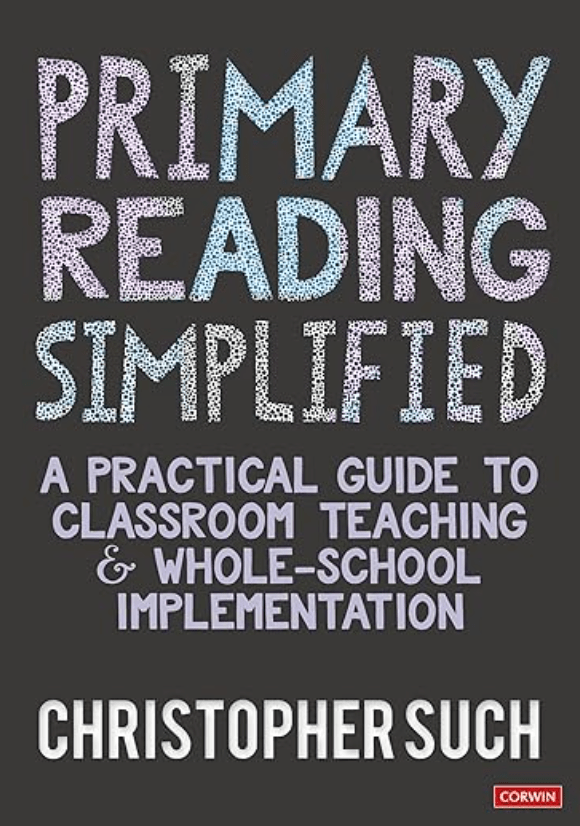
If you want to find out more about evidence-informed, tried-and-tested approaches to post-phonics reading instruction – including much more detail on the fluency read lesson structure described above – you might be interested in my book, Primary Reading Simplified.

You can buy it direct from the publisher (with a 30% discount and free delivery for a limited time by using the code UK30BOOKS) here: https://uk.sagepub.com/en-gb/eur/primary-reading-simplified/book292010
Alternatively, if you prefer Amazon, you can find it here: https://www.amazon.co.uk/Primary-Reading-Simplified-Whole-School-Implementation/dp/1036201414






 Primary Colour